
As at August 2026, three things are true at once about the federal independent contractor rule in the United States, and you need all three to answer the question honestly. The 2024 rule, "Employee or Independent Contractor Classification Under the Fair Labor Standards Act", published on 10 January 2024 at 89 FR 1638 and codified at 29 CFR part 795, is still the regulation on the books (Federal Register). The Department of Labor has not applied that analysis in its own investigations since 1 May 2025, when the Wage and Hour Division published Field Assistance Bulletin No. 2025-1 (Federal Register). And the rule that would replace 29 CFR part 795 is still only a proposal, published on 27 February 2026, with no final rule published under RIN 1235-AA46. Nothing new is in force. The 2024 regulation still governs private litigation, and the enforcement practice sits somewhere else.
The position below is United States federal law under the Fair Labor Standards Act and reflects the Department of Labor's rulemaking record for RIN 1235-AA46, current at August 2026. It is general information, not legal, tax or financial advice.
Which rule is actually in force?
The 2024 rule is. It was published as a final rule on 10 January 2024 at 89 FR 1638 under RIN 1235-AA43 and codified at 29 CFR part 795, and its effective-date line reads: "This final rule is effective on March 11, 2024." (Federal Register).
In the Department's own summary, it "is modifying Wage and Hour Division regulations to replace its analysis for determining employee or independent contractor classification under the Fair Labor Standards Act (FLSA or Act) with an analysis that is more consistent with judicial precedent and the Act's text and purpose" (Federal Register).
Five lawsuits were filed challenging that rule. On the Department's own account, "Each lawsuit remains pending, although each has been stayed based on the Department's representation that it intends to reconsider the 2024 Rule" (Federal Register). Pending and stayed is not decided, and none has altered what the regulation says.
Why the Department of Labor isn't applying it
On 1 May 2025 the Wage and Hour Division published Field Assistance Bulletin No. 2025-1, enforcement guidance in FLSA cases. Its instruction was blunt: "WHD will no longer apply the 2024 Rule's analysis when determining employee versus independent contractor status in FLSA investigations." In its place, WHD "will enforce the FLSA in accordance with [the 2008 version of Fact Sheet #13], and as further informed by [WHD Opinion Letter FLSA2025-2] with respect to any matters for which no payment has been made, directly to individuals or to DOL, for back wages and/or civil money penalties as of May 1, 2025." (Federal Register).
This changed what the agency applies when it investigates, not the regulation itself, and the bulletin says so: "[u]ntil further action is taken, the 2024 Rule remains in effect for purposes of private litigation and nothing in this FAB changes the rights of employees or responsibilities of employers under the FLSA." (Federal Register).
The Department still describes that position in the present tense, referring in February 2026 to "the analysis from FAB 2025-1 that the Department is currently applying" (Federal Register). Two analyses run side by side: one the agency uses in its own investigations, one that sits in the regulations for everyone else.
Much of the confusion here is a documentation problem, which is where a membership body helps.
What the 2026 proposal would change
It would change the regulation itself, if it is ever finalised. On 27 February 2026 the Department published "Employee or Independent Contractor Status Under the Fair Labor Standards Act, Family and Medical Leave Act, and Migrant and Seasonal Agricultural Worker Protection Act" at 91 FR 9932, under RIN 1235-AA46 and Docket No. WHD-2026-0001. Its action line reads "Notice of proposed rule; request for comments." Comments closed on 28 April 2026, and as at August 2026 no final rule has been published under that RIN, so the proposal has no legal effect (Federal Register).
The proposal is to "rescind the analysis for determining employee or independent contractor status under the Fair Labor Standards Act (FLSA) currently set forth in 29 CFR part 795 and replace it with the analysis that it published and adopted in a prior final rule dated January 7, 2021, with a few modifications." It also proposes to apply that analysis to the Family and Medical Leave Act and the Migrant and Seasonal Agricultural Worker Protection Act (Federal Register).
The 2021 rule it would restore was published on 7 January 2021 at 86 FR 1168. It framed five economic-reality factors, noting that those "factors are not exhaustive" and that "no single factor is dispositive." Two were identified as "core": the nature and degree of control over the work, and the individual's opportunity for profit or loss — "the most probative as to whether or not an individual is an economically dependent 'employee'", and factors that "therefore typically carr[y] greater weight in the analysis than any other factor" (Federal Register).
Read that as direction, not as a rule you can rely on; the Department's rulemaking page for RIN 1235-AA46 is where a final rule would appear (U.S. Department of Labor).
Where you stand, as at August 2026
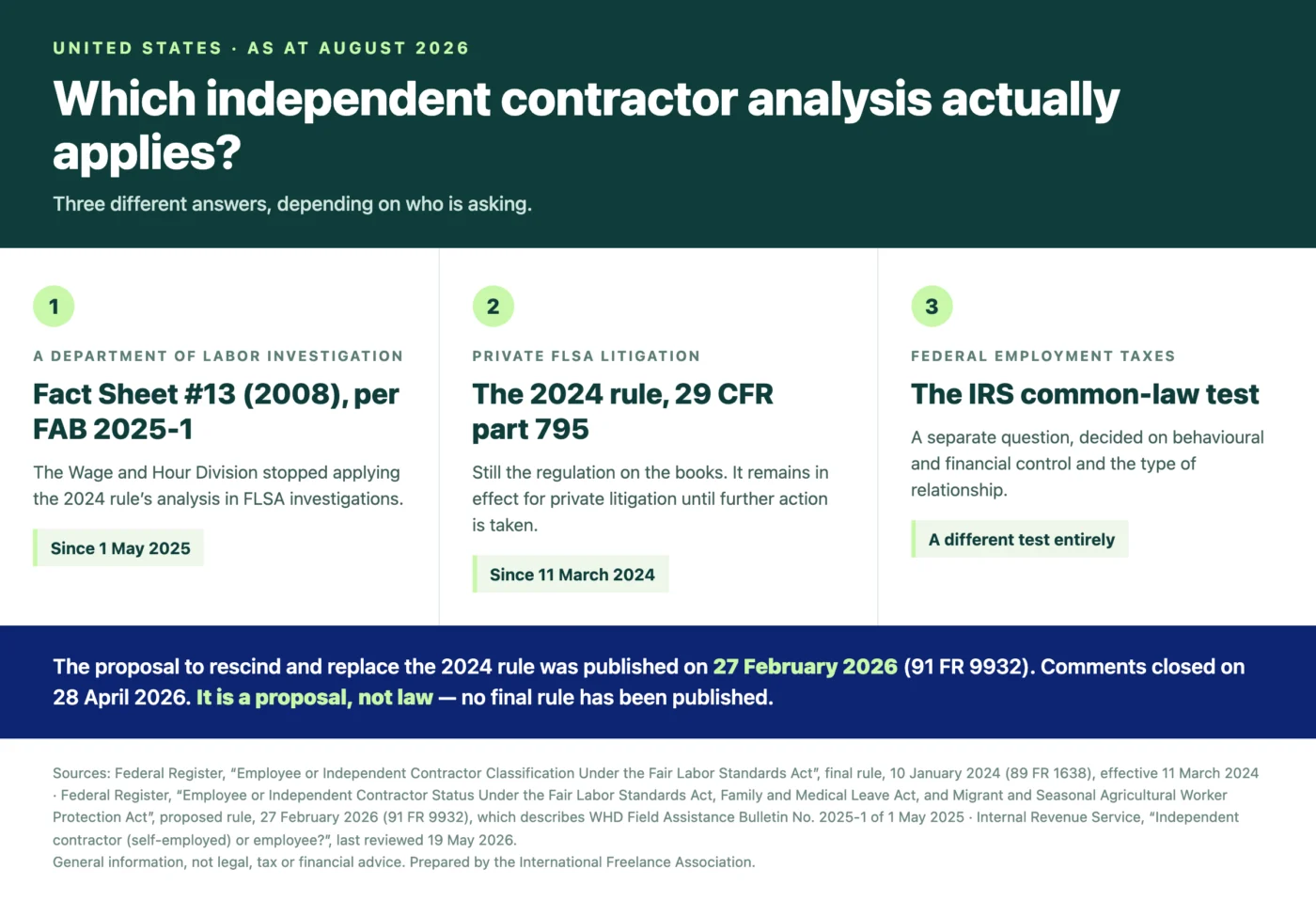
Which analysis touches you depends on who is asking the question, and these three contexts do not move together.
| Context | What applies | Since |
|---|---|---|
| A DOL wage-and-hour investigation | Fact Sheet #13 (2008) approach, per FAB 2025-1 | 1 May 2025 |
| Private FLSA litigation | The 2024 rule, 29 CFR part 795 | 11 March 2024 |
| Federal employment taxes | The IRS common-law test — a separate question | — |

The membership page sets out which frameworks and B2B contract standards sit behind a genuine-business position.
What this means if you work for yourself
The practical point is that "am I an independent contractor?" is not one question. Federal employment taxes are decided by a different body: the IRS uses a common-law test in three categories — behavioural, financial, and type of relationship — and states that "There is no 'magic' or set number of factors that 'makes' the worker an employee or an independent contractor and no one factor stands alone in making this determination" (IRS, page last reviewed 19 May 2026). Individual states apply their own tests for their own purposes as well. Our overview of independent contractor vs employee in the US sets out how those tests differ and why they can disagree about the same person; hirers may prefer our guide to engaging independent contractors without misclassification risk.
What none of them turns on is what your contract calls you. A services agreement naming you an independent contractor is evidence of intent, not a determination; the economic-reality factors look at the substance, starting with control over how the work is done and your opportunity for profit or loss.
That is the honest overlap with what we do. Operating as a real business — own clients, own tools, own pricing, real commercial risk, the ability to put a qualified substitute in — is what those factors examine, and it is what the IFA Independence Framework asks of a member, as our standards and certification page sets out.
Two things need saying plainly. Membership of any body, the IFA included, does not change anyone's classification: the IFA is a new self-regulatory membership body, our certification is our own standard rather than an externally accredited qualification, and status follows from how the work is actually done. And this is general information rather than legal, tax or financial advice — the rules differ between federal, state and tax law, and they change, so take professional advice on your own situation.

The standard we ask members to meet is published, along with what it does not claim.
Frequently asked questions
Is there a new independent contractor rule in 2026?
No. The Department of Labor published a proposal on 27 February 2026 at 91 FR 9932 under RIN 1235-AA46, and comments closed on 28 April 2026. As at August 2026 no final rule has been published under that RIN, and a proposal has no legal effect, so the regulation on the books remains the 2024 rule at 29 CFR part 795 (Federal Register).
Which test does the Department of Labor use right now?
In its own FLSA investigations, the Wage and Hour Division applies the 2008 version of Fact Sheet #13, as further informed by WHD Opinion Letter FLSA2025-2, following Field Assistance Bulletin No. 2025-1 of 1 May 2025 (Federal Register). In February 2026 the Department called that "the analysis from FAB 2025-1 that the Department is currently applying".
Does the 2024 rule still apply?
Yes, for private litigation. FAB 2025-1 states that "[u]ntil further action is taken, the 2024 Rule remains in effect for purposes of private litigation and nothing in this FAB changes the rights of employees or responsibilities of employers under the FLSA." The rule took effect on 11 March 2024 and remains codified at 29 CFR part 795 (Federal Register).
Is the IRS test the same as the Department of Labor test?
No. They are separate tests, run by separate bodies for separate purposes. The IRS decides status for federal employment taxes using a common-law test across behavioural, financial and type-of-relationship categories (IRS). The Department of Labor's economic-reality analysis under the FLSA concerns wage-and-hour obligations. They can reach different answers about the same person.
Does my contract decide whether I am an independent contractor?
No. These tests look at how the relationship actually works — control over the work, opportunity for profit or loss, the wider economic reality — rather than at the label in the agreement. A written contract is evidence of what the parties intended; it does not settle the question on its own.
Until a final rule is published, the useful question is not "what is the new rule?" but "which body is asking, and under which law?"