
A one-person firm becomes a genuine business — not just a person doing freelance tasks — when it operates like one across a few clear dimensions. It can deliver even if the founder can't (replaceability, through substitution or continuity), it takes commercial responsibility for its work and its risk, it isn't economically captive to a single client, it has operational autonomy over how it works, and it runs on real business infrastructure: contracts, invoicing, standards and systems. At the IFA we group these five qualities as our Independence Framework — our own standard for what a genuine independent business looks like. They are also, not by coincidence, the qualities serious clients trust, and (separately) the ones that a country's employment-status rules examine. This post explains each sign, how clients and status tests read them, and how to evidence that you operate as a real business. It is general information, not advice.
This is general information, not legal or tax advice. What makes someone genuinely "in business" is examined differently in different countries, and the rules change; the UK examples below won't all apply elsewhere. Take professional advice on your own situation.
What actually makes a freelancer a "business"?
"Freelancer" describes how someone works — independently, project by project — but it says nothing about whether there is a business underneath. The honest line, and the one the IFA is built around, is simple: a freelancer has clients; a one-person firm is run like a business. The difference is a shift in what you actually sell and how you carry yourself, not in how big you are.
Someone selling hours is, in effect, renting themselves out — paid for time, directed by the client, exposed to little risk, and offering no continuity if they are unavailable. A genuine one-person business sells an outcome instead. It quotes for a defined piece of work, controls how that work is delivered, stands behind the result at its own cost when something goes wrong, and can keep delivering even when the founder is ill, on holiday or busy elsewhere. None of this requires a large company or a team; plenty of single-person consultancies operate exactly this way. What it requires is that the business, and not only the person, is real.
That shift is worth making for two reasons that have nothing to do with vanity. Serious clients — the ones with procurement teams and compliance concerns — treat the two very differently. And, separately, the rules that decide employment status in most countries are looking for the same underlying thing: evidence that you are genuinely in business, rather than an employee in all but name. Getting the substance right serves both audiences at once.
The five signs of a genuine independent business
So what does "run like a business" actually mean in practice? At the IFA we group it into five signs — what we call the Independence Framework. To be plain from the outset: this is our own standard, a framework we publish and assess members against. It is not a government test, not accreditation, and not a legal definition of your status. It is a practical way to describe — and evidence — what a genuine one-person firm looks like.
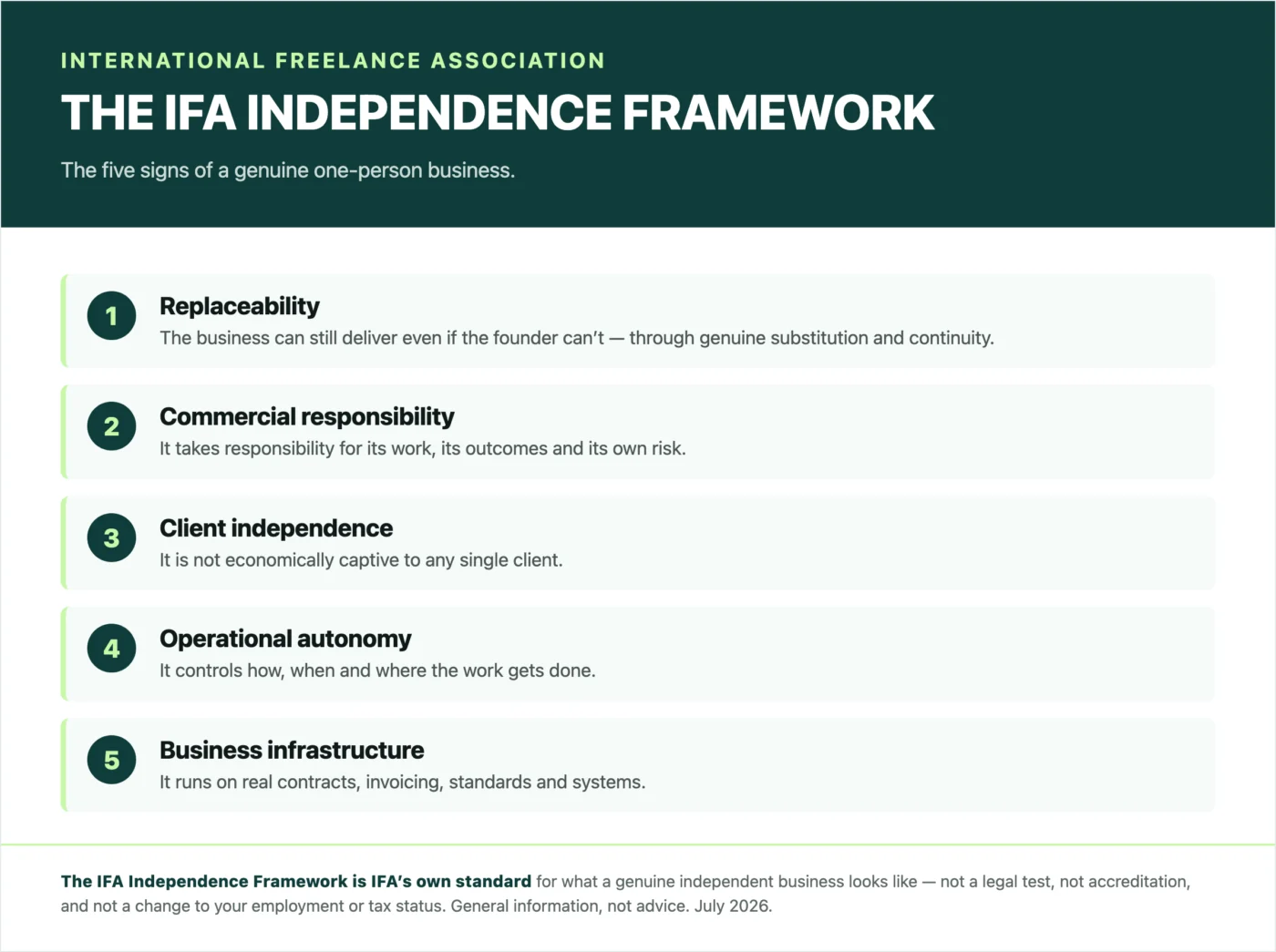
The five signs, and what each one means in practice, are:
| Sign (pillar) | What it means in practice |
|---|---|
| Replaceability | The business can deliver even if the founder can't — through substitution or continuity, not a single point of failure |
| Commercial responsibility | It takes responsibility for its work, its outcomes and its risk, rather than being told what to do and paid regardless |
| Client independence | It isn't economically captive to a single client — it could survive losing the biggest one |
| Operational autonomy | It controls how it works — the methods, tools and schedule are its own |
| Business infrastructure | It runs on real contracts, invoicing, standards and systems, not ad-hoc arrangements |
Read together, these describe a business rather than a job. Replaceability is the one solo professionals most often miss: a real business can support continuity and substitution so a client is not left stranded if you are unavailable. Commercial responsibility means you own the outcome and the risk — you fix what is wrong at your own expense, and you can profit or lose. Client independence means no single client effectively employs you. Operational autonomy means you decide the how. Business infrastructure means the unglamorous machinery — contracts, invoicing, records, professional standards — is genuinely in place, not improvised.
No single sign makes you a business, and no single weak spot sinks you. It is the pattern that counts. The more of these are genuinely true — and evidenced — the more clearly you operate as an independent business rather than a disguised employee. Because this is the IFA's own standard, meeting it is a signal we can recognise; it is not, and never claims to be, a ruling on your legal status.
How do clients — and status rules — tell the difference?
Serious clients read these signs before they sign anything. A procurement or hiring manager engaging an independent is weighing two risks at once: will the work actually get delivered, and does this arrangement look like employment dressed up as a contract? A supplier that quotes properly, carries its own risk, contracts on business terms and can provide continuity answers both worries. One that looks like a single, supervised, exclusive pair of hands raises them. This is why operating like a business is not cosmetic — it is what makes a cautious client comfortable saying yes.
The same signals sit behind the legal question of status — but here jurisdiction matters, and this is where you have to be careful. In the UK, the test is whether you are "in business on your own account". gov.uk puts it plainly: "A person is self-employed if they run their business for themselves and take responsibility for its success or failure" (gov.uk). The indicators it lists are business-like — you put in bids or quotes, you invoice, you are not under direct supervision, you carry your own risk, you get no holiday or sick pay, and you work under a contract for services. Behind that sit the three factors UK courts and HMRC weigh: control (who decides how, when and where the work is done), personal service (whether you must do the work yourself or hold a genuine right of substitution), and mutuality of obligation (an ongoing duty to offer and accept work). We cover this in depth in our guide to being in business on your own account.
That test is UK-specific. It is not a global rule, and it should not be quoted as one. In the US, the same underlying question — genuinely in business, or really an employee? — is answered by different legal tests: the IRS common-law test, the Department of Labor's economic-reality test, and various state ABC tests. They weigh different factors and reach the decision in their own way, and other countries differ again. The point is worth stating clearly: the legal test is country-specific, but the principles of operating like a real business travel. A firm that controls its work, carries its own risk, can substitute, and runs on real infrastructure looks like a genuine business almost anywhere — even though only your own jurisdiction's test decides your status, and only against your actual working arrangement.

How the IFA helps you evidence it — honestly
Knowing what a genuine business looks like is one thing; being able to show it is another. This is where a membership body can help — and where it is important to be exact about what that help is and is not.
The IFA gives members practical tools to evidence that they operate as a genuine independent business: the Independence Framework as a working checklist, B2B contracting standards and a contract pack, access to a substitution network that makes replaceability real rather than theoretical, dispute and late-payment escalation support, and — for those who meet the standard — the IFA Certified Independent Professional credential as a signal clients can recognise. You can read how we frame it on our standards and certification hub.
Now the honest part, said plainly because it matters most. The IFA Independence Framework and the Certified credential are the IFA's own standard — a self-awarded mark we publish and assess against. They are not accreditation, not regulation, not a government test, and not a legal ruling on your status. Membership does not change your employment or tax status: that depends on your actual working arrangement and the test that applies in your country, not on any credential we or anyone else issues. What good structure does is help a genuine position be an evidenced, defensible one when a serious client — or a status check — looks closely. It helps you show what is already true; it cannot make untrue things true.

Frequently asked questions
Is freelancing a business? It can be, and the stronger your business substance, the more clearly it is one. Freelancing becomes a genuine business when you carry real financial risk, control how you work, can deliver even when you are unavailable, aren't captive to a single client, and run on proper infrastructure — rather than working in an employee-like way for one client who directs you.
What makes a freelancer a business? The shift from selling hours to running a business: quoting for defined outcomes, taking commercial responsibility for the work and its risk, keeping independence from any single client, controlling how you deliver, and operating on real contracts, invoicing and standards. The IFA groups these as five signs in our Independence Framework — our own standard, not a legal test.
What is a one-person business? It is a genuine business run by a single person — a "one-person firm". It differs from casual freelancing in substance rather than size: it sells outcomes, carries its own risk, can support continuity if the founder is unavailable, and runs on business infrastructure. Being one person is not the point; being run like a business is.
How do you look professional as a freelancer? By being a genuine business, not by appearing to be one. Contract on B2B terms, invoice properly, quote for defined work, carry your own cover and tools, keep clean records, and be able to provide continuity or a substitute if you are unavailable. Serious clients read those signals; a polished profile that does not match how you actually operate convinces no one who looks closely.
Is the IFA Independence Framework an official standard? No. The Independence Framework and the IFA Certified Independent Professional credential are the IFA's own standard — a self-awarded mark we publish and assess against. They are not accreditation, not regulation, not government-backed, and not a legal test of your status. They help you evidence that you operate as a genuine business; they do not change your employment or tax status, which depends on your real arrangement and your country's rules.
Are you a person with clients, or a business?
The distinction is worth getting right, because it changes how you are paid, how seriously you are taken, and how exposed you are. If you can deliver even when you cannot personally show up, take responsibility for your work and its risk, aren't captive to one client, control how you work, and run on real contracts and systems, you operate as a genuine independent business — and both clients and status rules will read you that way. If several of those are thin, you have clients but not yet a business, and closing that gap is the most valuable thing a serious independent can do. That is the work the IFA's framework and standards are built to support — honestly, as our own standard, and as evidence of a position that has to be genuine to hold.