
A freelance or independent contractor agreement is a business-to-business contract for services — an arrangement between two businesses, not a contract of employment. A solid one covers nine essentials: the parties (correctly named), the scope of work and deliverables, the fees and payment terms, intellectual property (who owns the work and any licence granted), confidentiality, liability, indemnity and insurance, term and termination, a right of substitution, and an independent-contractor / B2B status clause confirming this is a contract for services rather than employment. The precise wording — and the legal effect of that status clause — depend on the country whose law governs the contract, because contract, status and tax rules differ by jurisdiction and change over time. This post is general information to help you review a contract, not legal advice; take professional advice on your own situation.
This is general information about what a freelance or independent contractor agreement typically contains, not legal advice. Contract law — and the status and tax consequences of how an agreement is written — vary from country to country and change over time; a clause that works in one jurisdiction may not in another. Take professional advice on your own contract before you rely on it.
What is an independent contractor agreement (and how is it different from an employment contract)?
An independent contractor agreement is a contract for services between two businesses: your one-person firm agreeing to deliver a defined result, and a client agreeing to pay for it. That single phrase — for services, not of service — is the hinge. A contract of employment hires a person into a role, with the give-and-take of employment behind it: an ongoing obligation on both sides, the employer's control over how the work is done, and the holiday, notice and employment rights that come with the relationship. A contract for services engages a supplier to produce an outcome, on terms the two businesses negotiate as commercial equals.
That difference should show up in how the agreement reads. An employment contract describes a role and a person's place inside an organisation; a good contractor agreement describes deliverables, a price and the terms of supply — the sort of document one business sends another. It names your business as the supplier, defines what you will deliver rather than a job you will hold, and leaves you in control of how you do the work. Whether the arrangement is genuinely independent, though, isn't settled by the label at the top of the page — a point that earns its own section below, because the law in each country tests the reality, not the wording.
What clauses should a freelance contract include?
A dependable freelance contract does the same nine jobs in almost any market, even though the legal weight of each clause shifts by country. Think of them as the questions a well-drafted agreement answers before a dispute can raise them: who is contracting, for what, at what price, who owns the result, what stays confidential, who carries which risk, how it ends, whether you can be replaced, and on what basis you are engaged. The table sets out each essential and what it does.
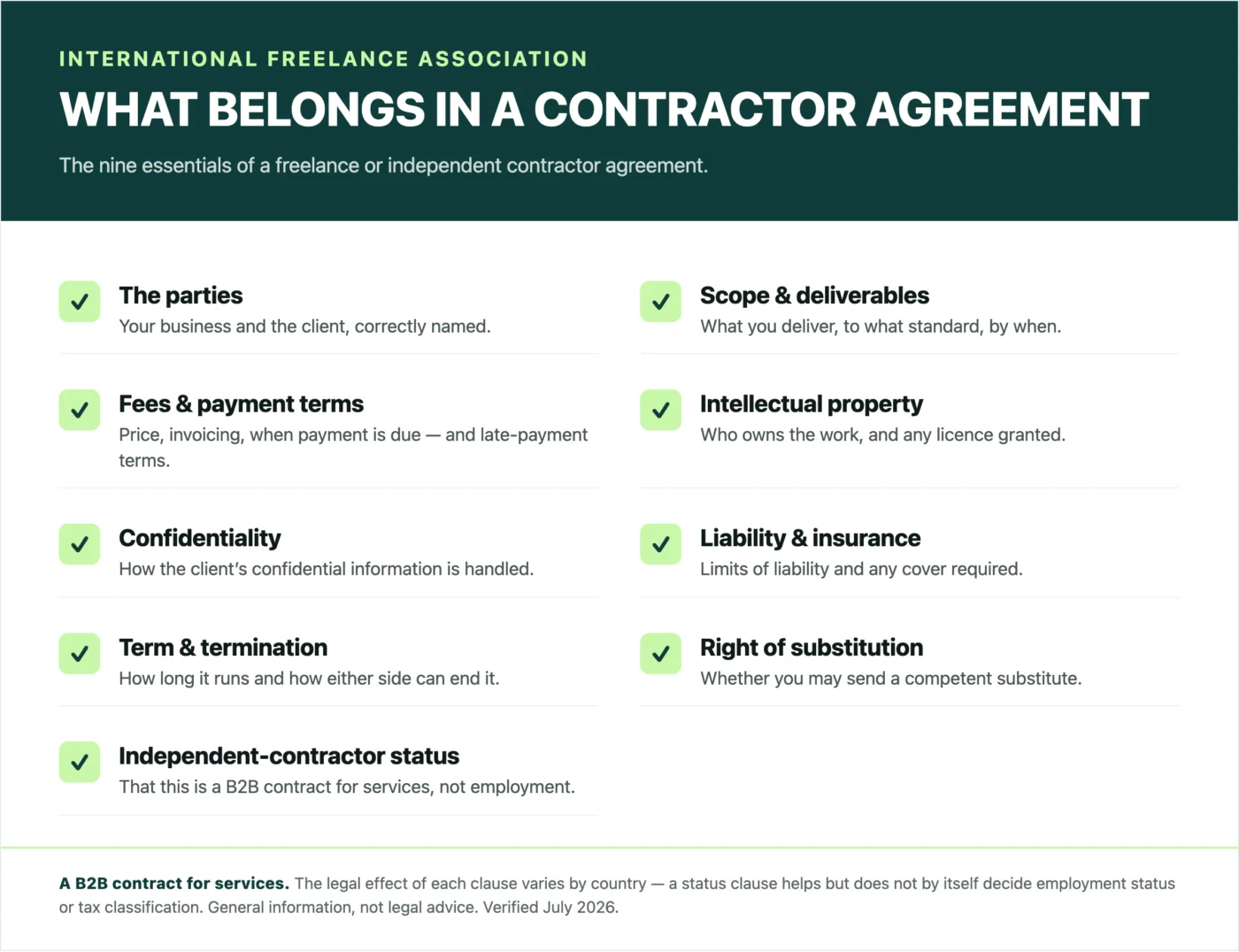
| Clause | What it does |
|---|---|
| The parties | Names your business and the client correctly, so it's clear which two businesses are contracting. |
| Scope of work / deliverables | Defines what will be delivered, to what standard and by when — defined outcomes, not an open-ended role. |
| Fees and payment terms | Sets the price, what triggers payment, how you invoice, when payment is due and what happens if it's late. |
| Intellectual property | States who owns the work produced and the terms of any licence granted. |
| Confidentiality | Governs how each side handles the other's confidential information. |
| Liability, indemnity and insurance | Sets limits of liability, any indemnities, and any insurance cover the client requires. |
| Term and termination | Says how long the contract runs and how either side can bring it to an end. |
| Right of substitution | States whether you may send a competent substitute to do the work. |
| Independent-contractor / B2B status | Records that this is a contract for services between businesses, not employment. |
A few of these carry more freight than their length suggests. Scope is where most disputes begin: an agreement promising "ongoing support" invites scope creep and starts to read like a role rather than a supply of services — define the deliverables, the standard and the deadline instead. Intellectual property should say plainly whether ownership passes to the client on payment or whether you licence it, because silence here is where fallings-out happen. Liability, indemnity and insurance is about who carries which risk: a cap on your liability, any indemnity you give, and any cover the client asks you to hold — and carrying your own insurance and risk is one of the marks of a genuine business, not an employee. A right of substitution — the ability to send a competent replacement — is more than a convenience clause; in some jurisdictions it is one of the signals that you are running a business rather than filling a job, which is why it earns a closer look later.
If you'd rather start from a drafted set of these clauses than a blank page, the IFA contract pack in the Professional tier gives members a B2B template and standards to work from — a starting point to adapt with your own professional advice, not a substitute for it.
How should the contract handle payment and late payment?
Payment is the clause independent professionals feel most sharply, so it pays to be exact. A strong agreement spells out four things: the price (fixed fee, day rate or milestones), what triggers payment (acceptance of a deliverable, a milestone reached, a monthly invoice), how and when you invoice, and when payment falls due — a specific number of days from the invoice, not "on completion" or "in due course". It should also say what happens when payment is late: the right to charge interest, to pause work, or to suspend a licence until the invoice is settled. Where payment terms are vague, an agreed payment window quietly stretches into months.

What you can charge for late payment is one of those rules that is country-specific, so scope it carefully. In the UK, business-to-business debts carry a statutory right to interest and fixed compensation under the Late Payment of Commercial Debts (Interest) Act 1998, even where the contract is silent — the figures and how to apply them are set out in the UK rules on charging late-payment interest, which is the place to get the current numbers rather than working them from memory. That statutory backstop is a UK rule; in the US, the EU and elsewhere the position differs, which is exactly why your contract's own late-payment terms matter — they are the protection you can rely on wherever you are.
Getting these terms right on every engagement is repetitive work, which is where a standard helps. The IFA contract pack gives members a B2B template with payment and late-payment terms already drafted to adapt — a framework and a starting point, not legal advice, and not a guarantee that a client will pay on time. It won't collect the debt for you, but it gives you a stronger position to chase one from.
Does a contract decide whether you're a contractor or an employee?
No — and this is the most important honest point in the whole document. A clause stating that you are an independent contractor engaged on a business-to-business basis helps: it records what both sides intend, and it's a sensible thing to include. But it does not, on its own, determine your employment status or your tax classification. What decides that is the real working arrangement — how much control the client has, whether you can genuinely be replaced, whether there's an ongoing obligation on both sides — measured against the test used in the country whose law applies. If the paperwork says "contractor" but the day-to-day looks like employment, the reality tends to win.
Which test applies depends entirely on where you are. In the UK, an engagement is measured against the off-payroll working rules (IR35), and HMRC's CEST check weighs factors like control, personal service and mutuality of obligation (gov.uk on being a self-employed contractor); how a genuine right of substitution works under the UK's IR35 rules is one strand of that, and a substitution clause only counts if it reflects what could really happen. In the US, classification runs on the IRS common-law test, Department of Labor and state tests (such as the ABC test), and it shows up in the paperwork as a Form 1099-NEC for an independent contractor versus a Form W-2 for an employee (irs.gov). The principle is the same in both countries and the mechanics differ: the written agreement supports a position, the working reality proves it. The surest ground is to operate as a genuine business — a freelancer who is truly in business on their own account, carrying real risk and real independence — so that an independent-contractor clause describes the truth rather than dressing it up.

Frequently asked questions
A few questions come up on almost every contract review. Short answers below; all of it is general information, and your own contract deserves professional advice on the law that governs it.
What is an independent contractor agreement? It's a business-to-business contract for services: your business agrees to deliver a defined result and the client agrees to pay for it, on commercial terms the two sides negotiate. It differs from a contract of employment, which hires a person into a role. A good one covers scope, fees, IP, confidentiality, liability, termination, substitution and status.
How do I write a freelance contract? Start from the nine essentials — parties; scope and deliverables; fees and payment; intellectual property; confidentiality; liability and insurance; term and termination; substitution; and independent-contractor status — and make each one specific to the engagement. Working from a tested template is quicker and safer than a blank page. Then have it reviewed against the law of the country whose rules govern the contract.
What are the common clauses in a contractor agreement? The parties; the scope of work and deliverables; fees and payment terms; intellectual property; confidentiality; liability, indemnity and insurance; term and termination; a right of substitution; and an independent-contractor or B2B status clause. Not every engagement weights each clause the same way, but a dependable agreement addresses all nine.
Does a contract make you an independent contractor? No. A status clause records what both sides intend and it helps, but it doesn't by itself decide your employment status or tax classification. That turns on the real working arrangement measured against the applicable country's test — IR35 and CEST in the UK; the IRS, DOL and state tests behind a 1099-NEC or W-2 in the US.
Do I need a written contract as a freelancer? It's strongly advisable. A written agreement makes the scope, price, payment terms and ownership clear before a dispute can arise, and it's the document you rely on if one does. Verbal or email-only arrangements can still bind, but they leave the important terms to memory — which is exactly what you don't want when an invoice is overdue.
A freelance or independent contractor agreement earns its keep by being specific: nine clauses that say who is contracting, for what, at what price, who owns the result and on what basis you are engaged — written to match how you actually work. The wording carries you a long way, but only where it reflects a real, independent business behind it; that reality is what any country's status test, and any client's finance team, ultimately reads.
If a drafted set of these clauses and a B2B standard to hold them to would save you starting from scratch, that's what IFA membership provides — templates, frameworks and escalation support, described plainly for what they are.