
In the US, whether you are an independent contractor or an employee is not decided by one test — it depends on which law is asking. For federal tax, the IRS applies its common-law test, weighing behavioural control, financial control and the type of relationship, with no single factor decisive (a contractor typically gets a Form 1099, an employee a Form W-2). For federal wage-and-hour law under the FLSA, the Department of Labor uses an economic-reality test — and that standard is being changed in 2026: the DOL published a proposal on 26 February 2026 to rescind the 2024 rule. And several states, such as California, use a stricter ABC test for some purposes. Because these can reach different answers, treat each separately. One guardrail before we start: the UK's IR35 / CEST / off-payroll regime is UK-only and does not apply in the US.
This is general information about how US worker-classification principles work, not legal, tax or financial advice. The rules vary by state and the federal wage-and-hour standard is being changed in 2026; your classification depends on your actual working arrangement. Take professional advice before acting on your situation.
How does the IRS decide if you're an independent contractor or an employee?
For federal tax purposes, the IRS uses a common-law test that looks at the degree of control and independence in the working relationship, grouped into three categories. There is, in the agency's own words, "no 'magic' or set number of factors" — you weigh the whole relationship together and document it. (The IRS guidance was last updated 19 May 2026.)
The three categories are:
- Behavioral control — does the company control, or have the right to control, what the worker does and how they do the job? Detailed instructions and training point towards employment.
- Financial control — are the business aspects of the work controlled by the payer? This covers how the worker is paid, whether expenses are reimbursed, and who provides the tools and supplies. Someone who invests in their own equipment and can make a profit or loss looks more like a business.
- Type of relationship — is there a written contract, or employee-type benefits such as a pension, insurance or vacation pay? Will the relationship continue, and is the work a key aspect of the business? Open-ended, central work points towards employment.
The practical marker most independents recognise is the tax form: an independent contractor typically receives a Form 1099, while an employee receives a Form W-2. But the form follows the substance — getting a 1099 does not, by itself, make you a contractor if the underlying relationship looks like employment.
The honest takeaway is that the IRS does not run a checklist; it weighs the whole picture. That is why operating, and being able to evidence that you operate, as a genuine business — your own tools, your own clients, real commercial risk — matters more than any single clause.

A specific hook before you read on: if you want the frameworks and B2B contract templates that help a one-person firm look and operate like a real business, that is what membership is for.
Isn't there one federal rule? The DOL economic-reality test — and the 2026 change
There isn't a single federal rule, and the federal wage-and-hour standard is the one in flux. Separately from the IRS tax test, the Department of Labor decides who counts as an employee under the Fair Labor Standards Act (FLSA) — which governs minimum wage and overtime — using an economic-reality test. The question that test asks is whether, as a matter of economic reality, the worker is in business for themselves or economically dependent on the employer. It is a totality-of-the-circumstances analysis in which no single factor is decisive.
What you actually need to know is that this standard is being changed and is not yet finalised. The sequence, dated:
- The 2024 final rule (published 10 January 2024, effective 11 March 2024) set out the multifactor economic-reality test described above.
- In May 2025, the DOL issued Field Assistance Bulletin 2025-1, telling its investigators not to apply the 2024 rule and to revert to the earlier economic-reality analysis.
- On 26 February 2026, the DOL published a Notice of Proposed Rulemaking proposing to rescind the 2024 rule and reinstate the 2021 test, with a public comment period running through 28 April 2026.
So as at 2026-06-30, the federal wage-and-hour classification standard is mid-change: the 2024 rule is on the books but not being enforced, and a proposal to replace it is open but not yet finalised (see the DOL misclassification and rulemaking pages). Because this is moving, take professional advice on which version applies to your situation rather than relying on a snapshot.
What is the ABC test, and where does it apply?
On top of the two federal tests, state law adds its own. Many states — including California, Massachusetts and New Jersey — use a stricter ABC test for some purposes (wage orders, unemployment insurance and similar). The ABC test flips the default: a worker is presumed an employee unless the hiring entity can prove otherwise.
Take California, the most-cited example. Following the state Supreme Court's Dynamex decision in 2018, codified by Assembly Bill 5 (AB5) and effective from 1 January 2020, a worker is an employee unless the hiring entity proves all three of the following (California's Division of Labor Standards Enforcement):
- (A) the worker is free from the control and direction of the hiring entity in performing the work;
- (B) the worker performs work that is outside the usual course of the hiring entity's business;
- (C) the worker is customarily engaged in an independently established trade, occupation or business of the same nature as the work performed.
Prong (B) is the one that catches people: even a genuinely independent specialist can be reclassified if their work sits squarely inside what the hiring business normally does. And because the ABC test is a state-law standard, it does not apply everywhere or for every purpose — states differ, and some use it only for specific programmes. This is exactly why a US independent should be clear which law, and which state, a given question falls under.
Why it matters — and how the UK compares
The reason all this matters in practice is that the same person can be classified differently by different bodies. The IRS (tax), the DOL under the FLSA (wages) and a state ABC test (e.g. California) can each reach a different answer for the very same engagement — and, as above, the federal wage-and-hour rule is itself shifting in 2026. There is no single "am I a contractor?" verdict that settles every question at once.
It also helps to see what is, and is not, the US framework. The UK uses an entirely separate regime — IR35 / off-payroll, HMRC's CEST tool, and case-law factors such as control, the right of substitution and mutuality of obligation. That is UK law and does not apply in the US; it appears here only as a contrast. (If you operate across both markets, our explainer on how the UK's IR35 regime treats the right of substitution is the UK-side companion to this US guide.)
The comparison, by jurisdiction:
| United States | United Kingdom (contrast only — does not apply in the US) | |
|---|---|---|
| Tax / status test | IRS common-law test — behavioural control, financial control, type of relationship; no single factor decisive (1099 vs W-2) | IR35 / off-payroll, assessed with HMRC's CEST tool |
| Wage / employment test | DOL economic-reality test under the FLSA — changing in 2026 (NPRM published 26 Feb 2026 to rescind the 2024 rule; not yet finalised) | Employment-status case law |
| Key factors | Control, financial independence, nature of the relationship; some states add a stricter ABC test (e.g. California, from 1 Jan 2020) | Control · right of substitution · mutuality of obligation |
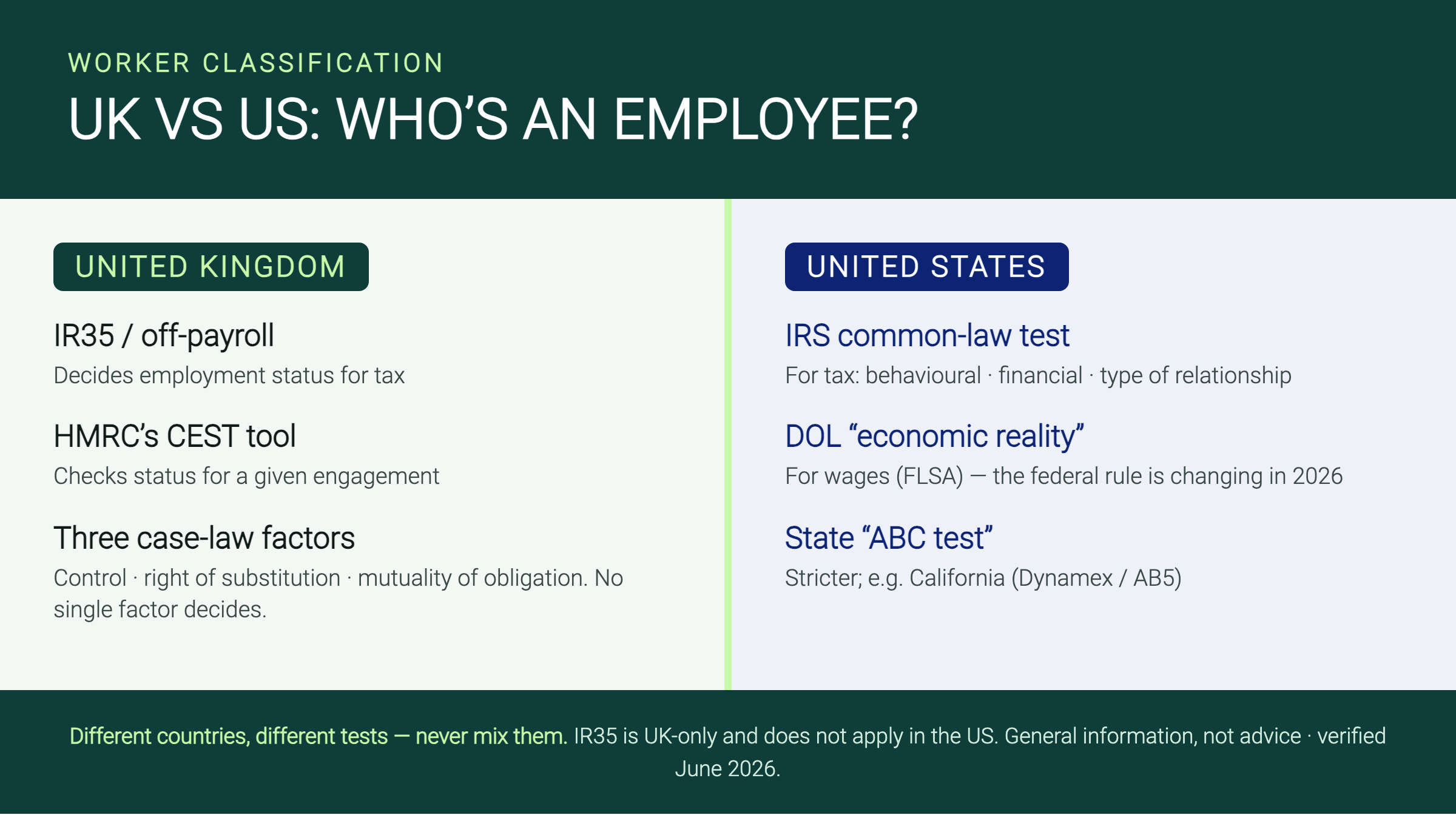 US worker classification uses the IRS, DOL and state tests; the UK's IR35/CEST regime is shown only for contrast and does not apply in the US.
The honest conclusion for an independent is the same as the practical one: because different bodies can classify you differently and the federal rule is moving, the durable answer is to operate as a genuine business — your own clients, your own tools, real commercial risk, clean B2B contracting — and to take professional advice on your specific position. This is where the IFA's wedge applies, honestly. The IFA is a new (2026) self-regulatory membership body: it provides frameworks, templates and support that help a one-person firm look and operate like a real business. To be clear, membership does not classify you, does not change your legal status, and cannot guarantee any classification outcome — that always depends on your actual working arrangement and the law that applies. What it can do is help you build and evidence the genuine-business substance the tests reward. (For the underlying principles, see freelancer or business — in business on your own account.)
A specific hook before you decide: if you want to know exactly which frameworks and contract standards back the "genuine business" position above, the membership page sets out what each tier includes.

The bottom line is that US worker classification is a set of separate tests, not one — and one of them is mid-change. Knowing which law is asking, scoping the question to the right state, and being a genuine business are what carry weight. That is the difference between looking independent and being independent.
Frequently asked questions
How does the IRS determine employee vs independent contractor? The IRS applies a common-law test that weighs the degree of control and independence across three categories: behavioural control (what work is done and how), financial control (payment, expenses, who provides tools), and the type of relationship (contracts, benefits, permanence, whether the work is central to the business). There is no magic number of factors — the whole relationship is weighed together. A contractor typically receives a Form 1099 and an employee a Form W-2. This is general information, not advice; take professional advice on your situation.
Is it better to be an employee or an independent contractor? There is no universal answer — it depends on your circumstances, and we can't advise you individually. Employees get benefits and protections such as minimum-wage and overtime cover; independent contractors get autonomy and can run a business, but carry their own tax, expenses and risk, and have fewer statutory protections. Critically, you don't simply choose your status — it follows from how you actually work under the IRS, DOL and state tests. Speak to a qualified professional about which fits your position.
What qualifies you as an independent contractor? Broadly, operating as a genuine business: being free from the hirer's control over how you do the work, bearing real financial risk (your own tools, expenses and chance of profit or loss), serving your own clients, and not being economically dependent on a single payer. The exact test varies by law and state — the IRS common-law test, the DOL economic-reality test, and stricter state ABC tests can each weigh this differently — so confirm your position with a professional.
What is the new rule for independent contractor vs employee? At the federal wage-and-hour level, the standard is being changed. The Department of Labor's 2024 final rule (effective 11 March 2024) set a multifactor economic-reality test, but in May 2025 the DOL told investigators not to apply it (Field Assistance Bulletin 2025-1), and on 26 February 2026 it published a proposal to rescind the 2024 rule and reinstate the 2021 test, with comments open through 28 April 2026. As at 2026-06-30 this is not yet finalised, so take professional advice on which version applies to you.
Does IR35 apply in the US? No. IR35 (off-payroll working) is a UK-only regime, assessed using HMRC's CEST tool and UK case-law factors such as control, the right of substitution and mutuality of obligation. It has no effect in the US. American worker classification is decided by the IRS common-law test (tax), the DOL economic-reality test (wages, currently being changed), and state law such as California's ABC test — never IR35.