
In the UK, if a business customer pays a commercial invoice late, you can charge statutory interest of 8% plus the Bank of England base rate. The base rate is 3.75% (held by the Monetary Policy Committee at its meeting ending 17 June 2026), so statutory late-payment interest is currently 11.75% a year, as at 30 June 2026 — and it can change, because it is reset against the base rate. You can also claim a one-off fixed sum on top: £40 for a debt up to £999.99, £70 for £1,000 to £9,999.99, and £100 for £10,000 or more. This right comes from the Late Payment of Commercial Debts (Interest) Act 1998 and applies to business-to-business (B2B) debts. If no payment terms were agreed, a payment is late 30 days after the customer receives the invoice or you deliver, whichever is later. One caveat: you cannot claim statutory interest if your contract sets its own different substantial interest rate.
This is general information about UK commercial late-payment rules, not legal, tax or financial advice. These figures change — the base rate is reviewed several times a year — and the rules apply in the UK to B2B debts only; other countries differ. Take professional advice before acting on your own situation.
How much interest can you charge on a late payment?
For overdue B2B invoices in the UK, the statutory rate is 8% plus the Bank of England base rate. With the base rate at 3.75% (set by the Monetary Policy Committee at its meeting ending 17 June 2026), that puts statutory interest at 8% + 3.75% = 11.75% a year, as at 30 June 2026. The Bank reviews the base rate several times a year, and the statutory rate is fixed by reference to the base rate in force on 30 June and 31 December for each six-month period — so check the current figure when you calculate (the next decision is due 30 July 2026). Alongside that interest, the legislation lets you claim a one-off fixed sum per late payment, in addition to the interest, on a sliding scale by debt size.
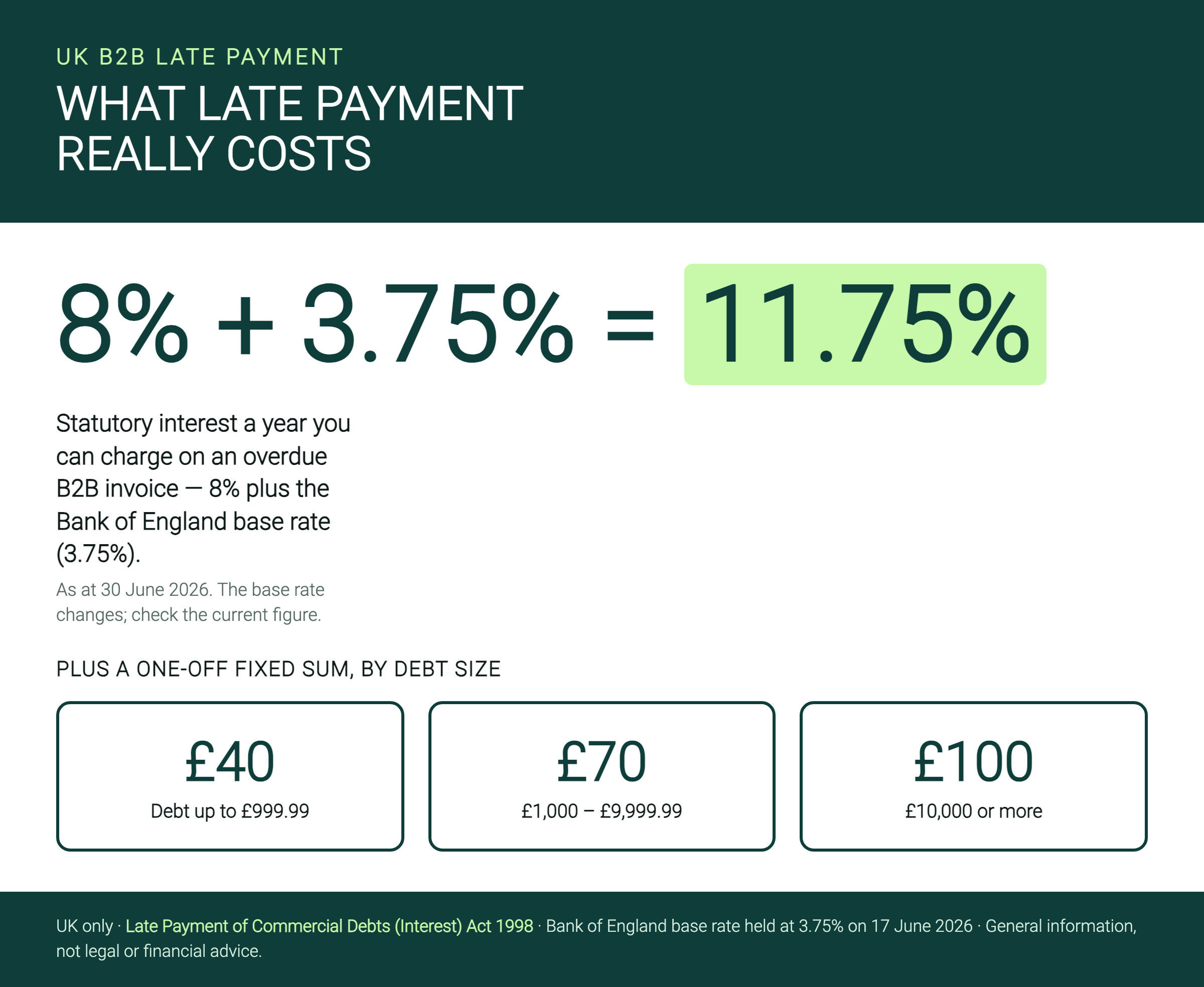 Fixed-sum compensation in the UK: £40 (debt up to £999.99), £70 (£1,000–£9,999.99), £100 (£10,000 or more) — once per late payment, on top of interest.
The fixed sum you can claim depends on the size of the debt, as set out in the Act:
| Size of the unpaid debt | Fixed-sum compensation |
|---|---|
| Up to £999.99 | £40 |
| £1,000 to £9,999.99 | £70 |
| £10,000 or more | £100 |
You claim the fixed sum once per late payment, on top of the interest. If your reasonable costs of recovering the debt are higher than the fixed sum, you can also claim those extra costs — more on that below. These figures and the rules on charging interest are set out in gov.uk guidance and the underlying legislation.
Charging interest is something a genuine business does — it invoices on commercial terms and enforces them. If you are weighing up whether you operate as a real business and what that brings, our guide on being in business on your own account sets out what that means in practice.
How do you work out what you're owed?
The method is straightforward. Work out the annual interest first, convert it to a daily figure, then multiply by the number of days the payment is late — and finally add the fixed sum. Annual interest is the debt multiplied by the rate (8% + base rate); daily interest is that annual figure divided by 365; the total interest is the daily figure multiplied by the number of days late.

Take a worked example. Say a client owes you £6,000 and the invoice is 40 days late, with the statutory rate at 11.75% (as at 30 June 2026):
- Annual interest: £6,000 × 0.1175 = £705
- Daily interest: £705 ÷ 365 = £1.93 a day (rounded)
- Interest for 40 days: £1.93 × 40 ≈ £77.26
- Plus the fixed sum: the debt sits in the £1,000–£9,999.99 band, so add £70
That gives roughly £147.26 on top of the £6,000 owed — the £77.26 in statutory interest plus the £70 fixed sum. Use the live base rate on the day you calculate, since the statutory rate moves with it.
When can you start charging, and what are the default terms?
You can charge statutory interest once a B2B payment is late, and what counts as "late" depends on the terms you agreed. If you and the customer did not agree payment terms, the default in the UK is that payment becomes late 30 days after the customer receives the invoice or after you deliver the goods or service, whichever is later. The clock for interest starts the day after that.
Where you do agree terms, there are limits on how long they can be. Agreed payment terms should usually be 30 days or less for public authorities and 60 days or less for business transactions — and a longer period is only allowed if it is not "grossly unfair" to you as the supplier. So a customer cannot simply impose a 120-day term and use it to keep the late-payment clock from ever starting.
There is one important exception to your right to statutory interest. You cannot claim statutory interest if your contract sets its own different, substantial interest rate for late payment. In other words, if your contract already provides a meaningful contractual rate, that is what governs — the statutory 8%-plus-base-rate route is the fallback where the contract is silent. This is why the wording of your own contract matters as much as the law behind it.
What if they still won't pay?
Interest and the fixed sum are your statutory baseline, but they are not the only money on the table. If your reasonable costs of recovering the debt exceed the fixed sum, you can claim those additional costs too — for example, where chasing the debt has run up real expense beyond the £40, £70 or £100. The gov.uk guidance on how to claim debt-recovery costs sets out that principle.

If a customer still will not pay, there is free help. In the UK, the Small Business Commissioner offers free support to small businesses in dispute with larger customers over unpaid invoices — a route worth knowing before you reach for solicitors or court. But the honest truth is that most of this is preventable. A clear B2B contract that states your payment terms, your late-payment interest and your right to costs up front does more to get you paid on time than any amount of chasing afterwards, because the customer knows the position from day one — and a one-person firm needs that commercial backbone to stay resilient when a client drags its feet, the same way it needs continuity cover for when work has to carry on without you.
This is one of the gaps the IFA is built to close. A Professional membership includes a B2B contract pack with payment terms built in, and late-payment and dispute escalation support — a framework, support and access, to help you set terms clearly and escalate when a customer won't pay. To be clear about what that is and isn't: it is not a debt-collection service, not legal advice, and not a guarantee that you will be paid. It is structure and support around a problem most independent professionals face alone.
Frequently asked questions
How much interest can I charge on a late payment? In the UK, for an overdue B2B invoice you can charge statutory interest of 8% plus the Bank of England base rate. With the base rate at 3.75%, that is 11.75% a year as at 30 June 2026 — but the rate changes, so check the current figure when you calculate. You can also claim a fixed sum of £40, £70 or £100 depending on the size of the debt, on top of the interest.
What is the interest rate for late payments? The statutory late-payment interest rate for UK commercial debts is 8% plus the Bank of England base rate. Because the base rate (3.75% as at 30 June 2026) is reviewed several times a year, the total rate moves with it; the statutory figure is fixed against the base rate in force on 30 June and 31 December for each six-month period. Always confirm the live rate on the day you work out what you are owed.
What is a reasonable interest rate for late payments? For UK B2B debts there is a defined statutory rate — 8% plus the Bank of England base rate — rather than a vague notion of "reasonable". You can set a different rate in your contract, but if that contractual rate is substantial it replaces your right to claim statutory interest. This is general information, not advice; rules vary by country and change, so take professional advice on your contracts.
When is a commercial payment officially late? If you agreed payment terms, the payment is late once those terms pass. If you did not agree any terms, the UK default is that payment becomes late 30 days after the customer receives the invoice or after you deliver, whichever is later. Agreed terms should usually be 30 days or less for public authorities and 60 days or less for business transactions, unless a longer period is genuinely not grossly unfair to you.
Can I claim compensation as well as interest? Yes. On top of statutory interest you can claim a fixed sum once per late payment — £40 for a debt up to £999.99, £70 for £1,000 to £9,999.99, and £100 for £10,000 or more. If your reasonable costs of recovering the debt are higher than that fixed sum, you can also claim the additional recovery costs.
If you want the contract terms and escalation framework behind all of this in one place, see what membership includes.